
Service page
Restaurant website design that makes the brand clearer and the next step easier.
Built by Pine designs restaurant websites for brands in Southern California and the Inland Empire that need stronger first impressions, faster mobile decisions, and better local visibility without falling back on templates.
From a recent client launch
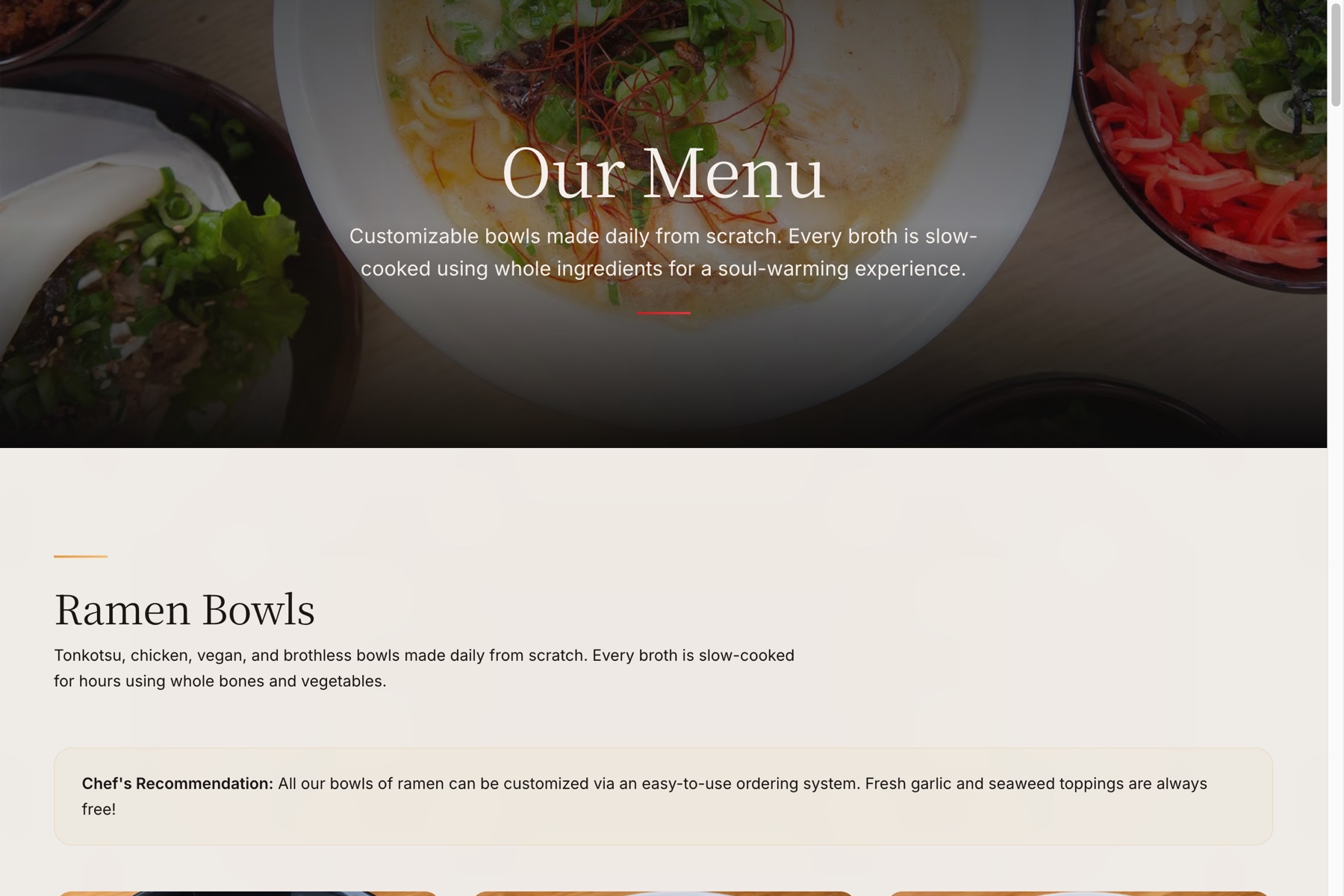
These visuals are from the Tatsu Ramen rebuild, used here because the page should show the kind of work it is talking about instead of leaning on generic restaurant stock.
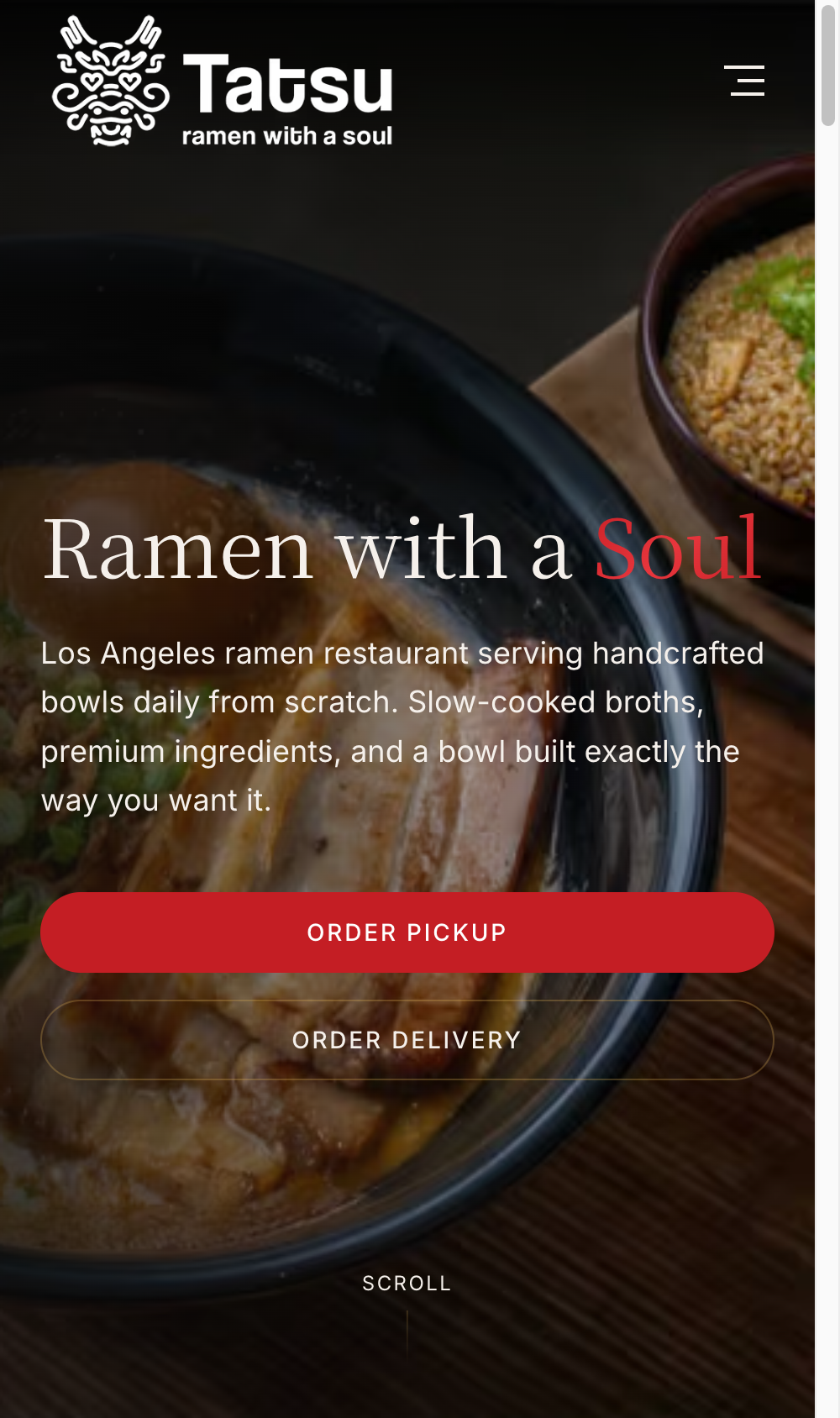
Homepage atmosphere
A real client launch built to feel cinematic on first load without losing clarity.
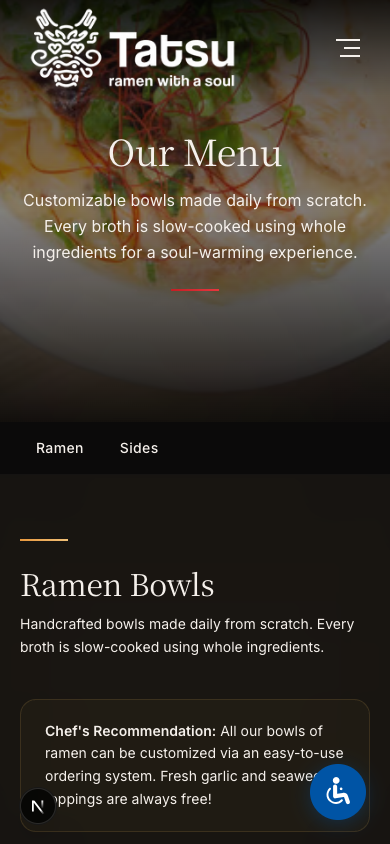
Mobile menu flow
The mobile path is shaped around what hungry visitors actually do next.
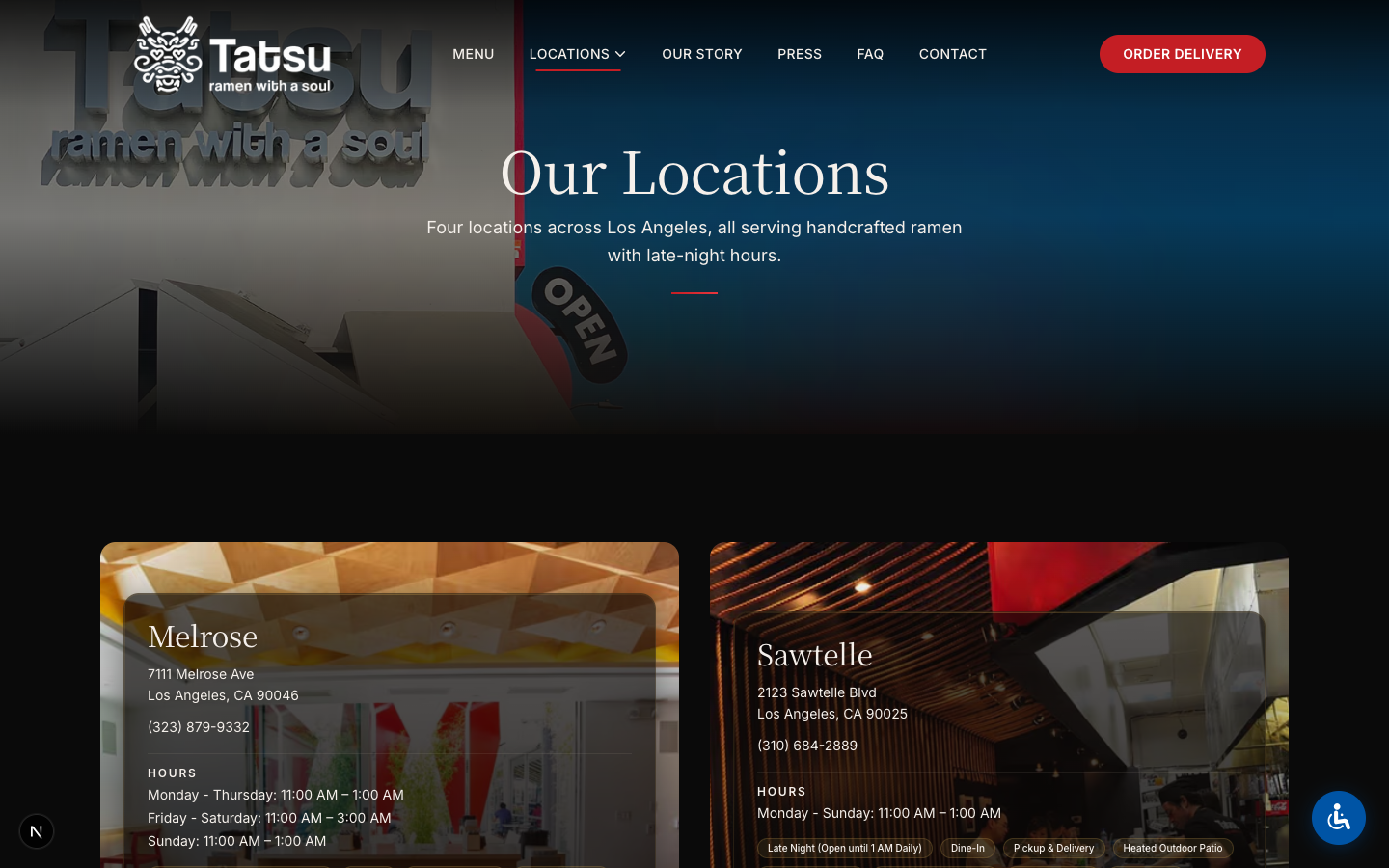
Location clarity
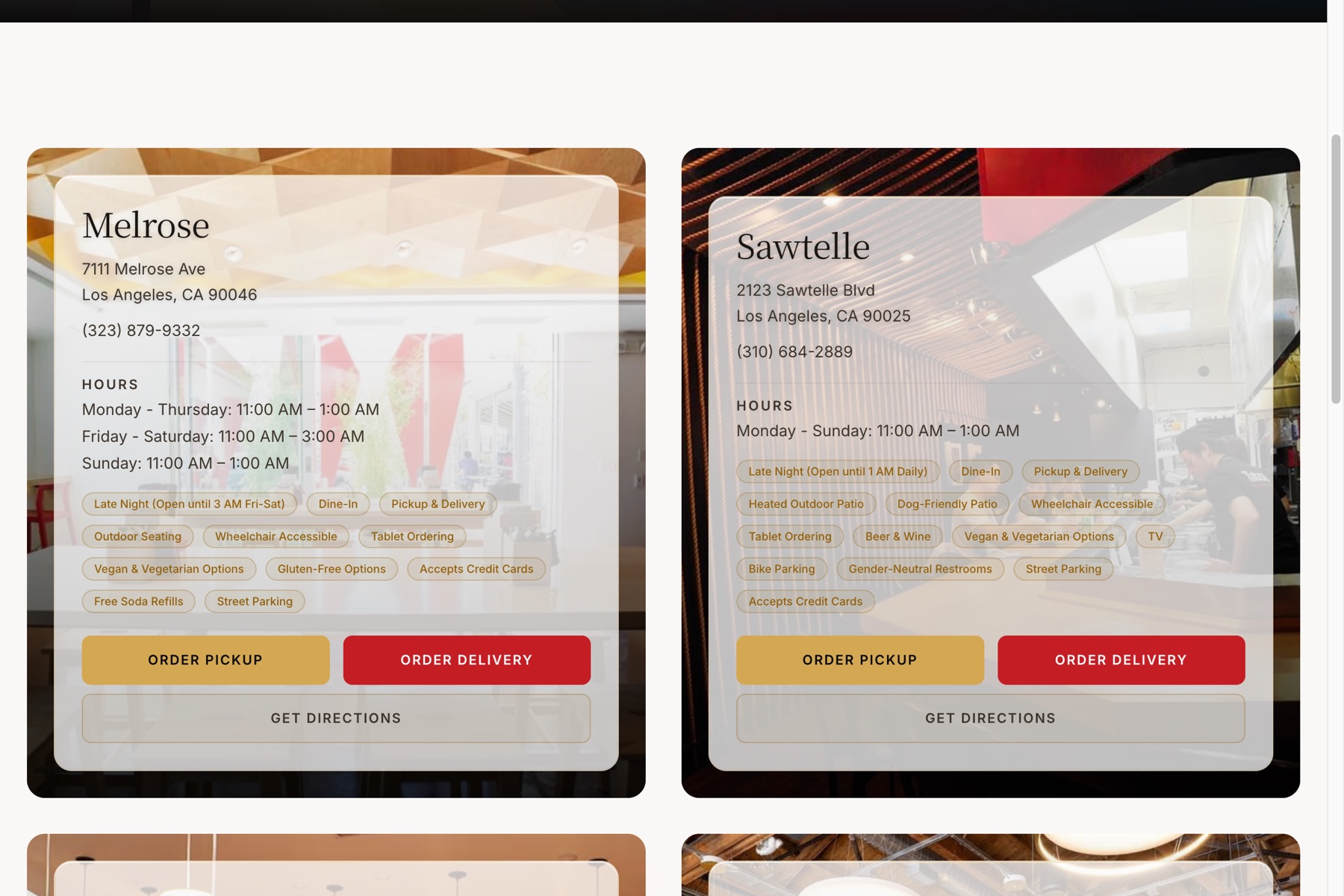
Multi-location structure is handled as core UX, not buried utility content.
Why restaurants
Restaurant sites fail in predictable ways.
The menu is hard to find, hard to read, or trapped in a PDF.
The site looks generic and does not feel like the restaurant in person.
Multi-location information is confusing or buried.
Mobile visitors drop before they reach ordering or directions.
What's included
A restaurant launch baseline, not just a homepage facelift.
The work is designed around appetite, speed, local discovery, and trust. That means the site has to feel like the restaurant, but it also has to help a visitor get to menu, locations, and ordering without friction.
Brand-led homepage design with a clear first impression
Menu, location, and ordering architecture built for phones first
Technical SEO foundations including canonicals, metadata, and schema
Accessibility-conscious patterns and launch review
Page speed and launch QA before the site goes live
Integrations
We ship sites that talk to the tools your operators already use.
Integrations are real engineering work, not copy-paste embeds. Each platform below ships with its own data model, its own loading cost, and its own accessibility quirks. We wire them in with proper auth, server-side handoffs where they help, and a launch QA pass that proves the order, the reservation, or the payment actually goes through.
Toast
POS-native online ordering and menu sync
ChowNow
operator-owned ordering with marketing tools layered in
Olo
enterprise ordering for multi-unit operators
OpenTable
reservation network with diner reach
Resy
reservation tooling and waitlist mechanics
Tock
reservation and prepaid ticket experiences
Square
payments, POS, and gift-card flows
Stripe
direct payment processing for catering and ticketed events
Pick the platform that fits the operation; we wire it in and pass the launch QA.
Accessibility
Accessibility built in — WCAG 2.2 AA conscious from day one.
Direct answer
Built by Pine ships every restaurant site against the WCAG 2.2 AA standard — the practical baseline US courts and DOJ guidance treat as the threshold for ADA Title III on the web. Keyboard navigation, alt text, color contrast, accessible forms, captioned video. Audited before launch, every project.
What we audit before a site goes live: keyboard reachability across the menu, ordering, and reservation paths; visible focus states on every interactive control; color contrast on body copy, button labels, and inline links; alt text on every menu item image and location card; accessible names on icon buttons and ordering CTAs; and form validation that surfaces errors to screen readers, not just the eyes.
How we work: accessibility lives inside the design system, not as a separate retrofit at the end. Tokens are checked for contrast as they're created, components ship with labels and focus states baked in, and the launch QA pass combines automated checks with manual review of the actual decision paths a diner takes. The result is a site that holds up on a screen reader, a keyboard, and a phone at 200% zoom — without bolt-on overlays.
More on what this looks like in practice in our journal post on restaurant website ADA compliance.
Pricing
What a restaurant website costs at Built by Pine.
Build cost
Most projects land between $10,000 and $30,000 depending on integrations, multi-location structure, accessibility audit depth, and brand work. A single-location site with one ordering platform sits at the lower end; a multi-location site with Toast or Olo, a custom design system, and a full accessibility audit sits at the higher end.
Ongoing care
Care plans run from $150 to $500 per month and cover hosting, security patching, accessibility regression checks, content updates, and small design changes. Operators who want quarterly performance and SEO reviews land on the higher end.
We broke down the full pricing across five tiers in How much does a restaurant website cost in 2026?
How it works
Timeline from kickoff to launch.
A custom restaurant website at Built by Pine ships in 8–12 weeks. Multi-location structure or deeper Toast / Olo integration can push it to 14–16.
| Week | Phase | Output |
|---|---|---|
| Week 1–2 | Discovery | Audit, sitemap, brand alignment |
| Week 3–6 | Design | Wireframes, design system, key pages |
| Week 7–10 | Build | Component build, content load, integrations |
| Week 11–12 | Launch QA | Accessibility audit, performance pass, DNS cutover |
Proof
The Tatsu rebuild is the clearest example of the standard.
We rebuilt the Tatsu Ramen site around brand atmosphere, location clarity, and a launch-ready performance baseline. The result is a more credible first screen and a cleaner path to the actions diners actually take.
On the Tatsu rebuild, the homepage and menu page each hit sub-2-second LCP on 4G, the locations dropdown moved from a hover affordance to a 2-tap mobile sheet, and the launch accessibility audit closed every WCAG 2.2 AA blocker before DNS cutover.
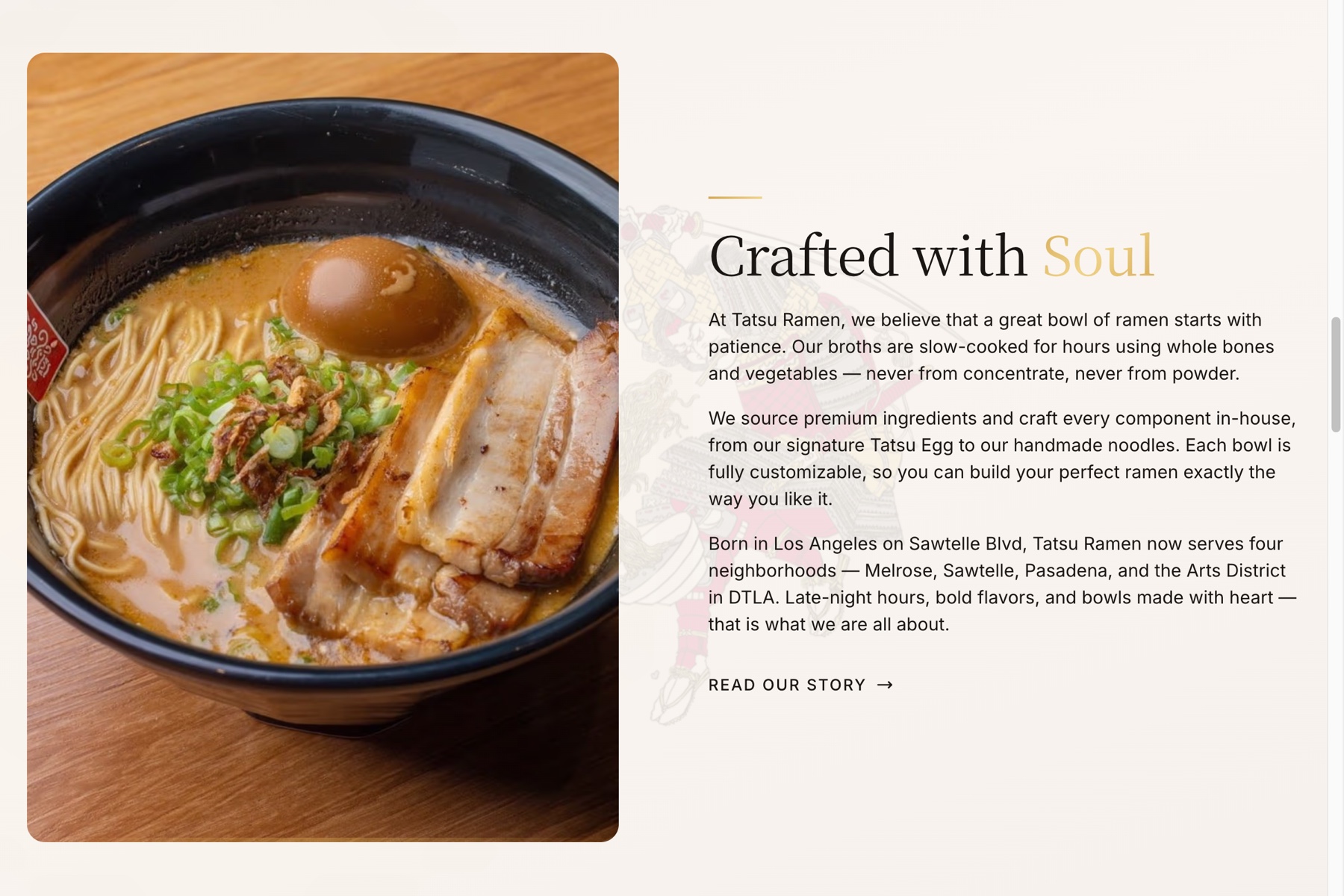
Client work
Brand-led homepage sections
Client work
Menu pages with appetite and hierarchy
Client work
Multi-location pages diners can act on
FAQ
Questions restaurant owners usually ask first.
Do you only work with restaurants in Southern California?
No. Southern California is our home market and where our location targeting starts, but we also work with restaurant brands outside the region when the fit is right.
Do restaurant websites need ADA compliance work?
Yes. Restaurant websites still need to be usable with keyboards, screen readers, and mobile assistive settings. A compliance-minded launch reduces risk and improves the experience for every visitor.
Can you redesign only the homepage?
Sometimes, but most restaurant sites underperform because the structure underneath is weak. We usually recommend fixing the homepage, menu path, and location flow together so the launch actually changes outcomes.
How fast can a restaurant site launch?
The right-sized projects typically launch in 7 to 14 days once content, imagery, and decision-makers are aligned.
Deep dives
Deep dives
Reads from the studio journal that operators ask about most.
Journal
How much does a restaurant website cost in 2026?
Journal
Restaurant website examples that actually convert
Journal
Multi-location restaurant websites: structure that scales
Journal
Online ordering vs. reservations: what goes first on your site
Journal
Restaurant website ADA compliance: what operators need to know